


The production of suitcases
From raw materials to finished product, a suitcase undergoes four main stages: cutting, shaping, assembly, and inspection, each involving more than ten meticulous processes. Streamlining, data-driven processes, and standardization are the core of modern luggage manufacturing and prerequisites for consistent quality.
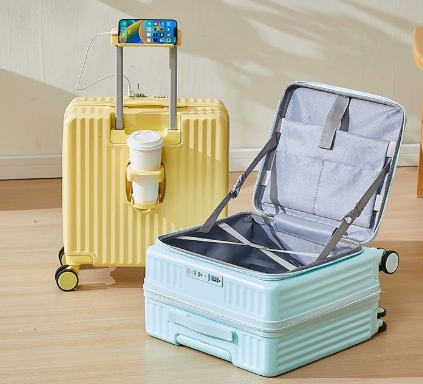
I. Cutting Stage: PC or ABS sheets are CNC-cut to a precision of 0.1mm to obtain the top, bottom, and side panels. Aluminum sheets are laser-cut with rivet holes, ensuring a hole position deviation of ≤0.05mm to prevent stress concentration during subsequent riveting.
II. Shaping Stage: Plastic sheets are heated to 200℃ using infrared light and then placed in a positive and negative pressure vacuum forming mold. They are cooled and shaped within 45 seconds, maintaining a thickness error of ±0.05mm. The aluminum shell is stretched three times using an 800T hydraulic press, resulting in uniform radius angles and an 18% increase in yield strength, providing a structural framework for the suitcase's impact resistance.
III. Assembly Section
Riveting: One blind rivet every 5cm on the aluminum frame, tensile strength ≥500N;
Mold Closure: Polyurethane adhesive is applied to the edges of the PC shell, and after pressing, it is left to stand for 2 hours, with a shear strength of 1.2MPa;
Assemblies: The universal wheel screw torque is 12N·m, and the aluminum tube of the pull rod is anodized and rust-free after 48 hours of salt spray testing;
Interior: The lining and foamed PE are integrally vacuum-formed, and the stitching uses a double-needle embedded clamp process, with 9 stitches per 3cm to ensure aesthetics and tensile strength.
IV. Inspection Section
Finished products must pass a 1.5m six-sided drop test, 5000 vibrations of the pull rod, and 8km wheel travel test. Any abnormality will result in the entire batch being reworked; finally, the zipper undergoes a 2-hour waterproof spray, and the humidity inside the case is <5%RH to be considered qualified, ensuring that it meets international transportation standards upon leaving the factory.
Summary
From sheet metal cutting to final assembly, a suitcase undergoes more than thirty processes and more than ten tests. Numerical control precision, temperature-controlled molding, and data-driven inspection transform metal and plastic into a reliable enclosure that can accompany you on journeys of tens of thousands of kilometers. Understanding the process allows you to see the technological value hidden in every seam and every rivet when making a purchase, beyond just the appearance.

